
Publications
8 papers in neural rendering, 3D vision, and biomechanics
2026
Interactive Real-Time Visual Avatar Generation: A Survey
Preprint, 2026
A survey of 100 methods (2023-2026) for photorealistic, audio-driven digital avatars, spanning GAN-based synthesis, NeRF, 3D Gaussian Splatting, flow-matching, and hybrid parametric body representations.
2025
HFGaussian: Human gaussian with biomechanics features
IEEE Transactions on Artificial Intelligence, 2025
HFGaussian extends 3D Gaussian Splatting to simultaneously render novel views and human biomechanical features — skeleton, keypoints, and dense pose — from sparse images in real time at 25 FPS.
2024
DiVa-360: The Dynamic Visual Dataset for Immersive Neural Fields
CVPR 2024, 2024
A large-scale dynamic visual dataset of 360° immersive multi-view recordings, designed to benchmark neural field methods for dynamic scene reconstruction and novel view synthesis, presented at CVPR 2024.
HFNeRF: Learning Human Biomechanic Features with Neural Radiance Fields
IEEE CAI 2024, 2024
A NeRF-based method that simultaneously reconstructs human appearance and estimates biomechanical features including 3D skeleton and dense pose, bridging neural rendering and human motion analysis for AR/VR.
GHNeRF: Learning Generalizable Human Features with Efficient Neural Radiance Fields
CVPR 2024, 2024
A generalizable neural radiance field that efficiently learns human-specific features from sparse observations, enabling real-time novel view synthesis without per-scene optimization, presented at CVPR 2024.
2022
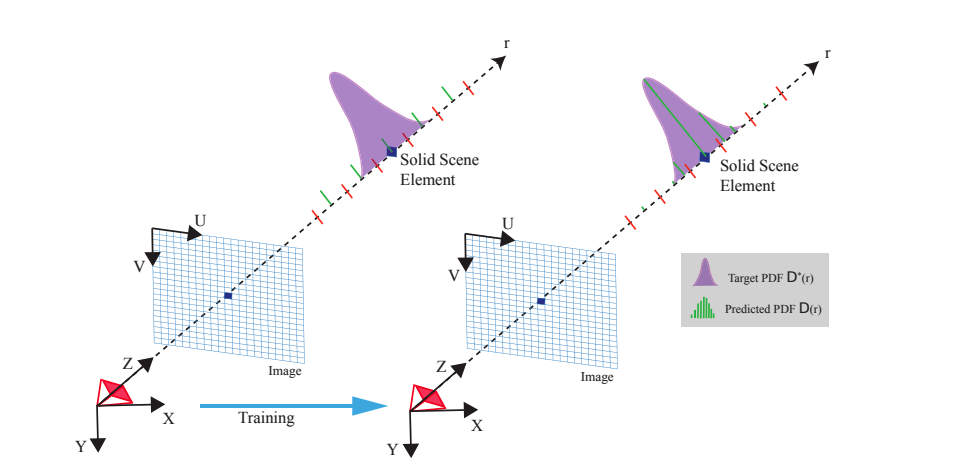
PNeRF: Probabilistic Neural Scene Representations for Uncertain 3D Visual Mapping
arXiv, 2022
A probabilistic neural scene representation that models uncertainty in 3D visual mapping, enabling more robust reconstruction under noisy sensor data and ambiguous observations.
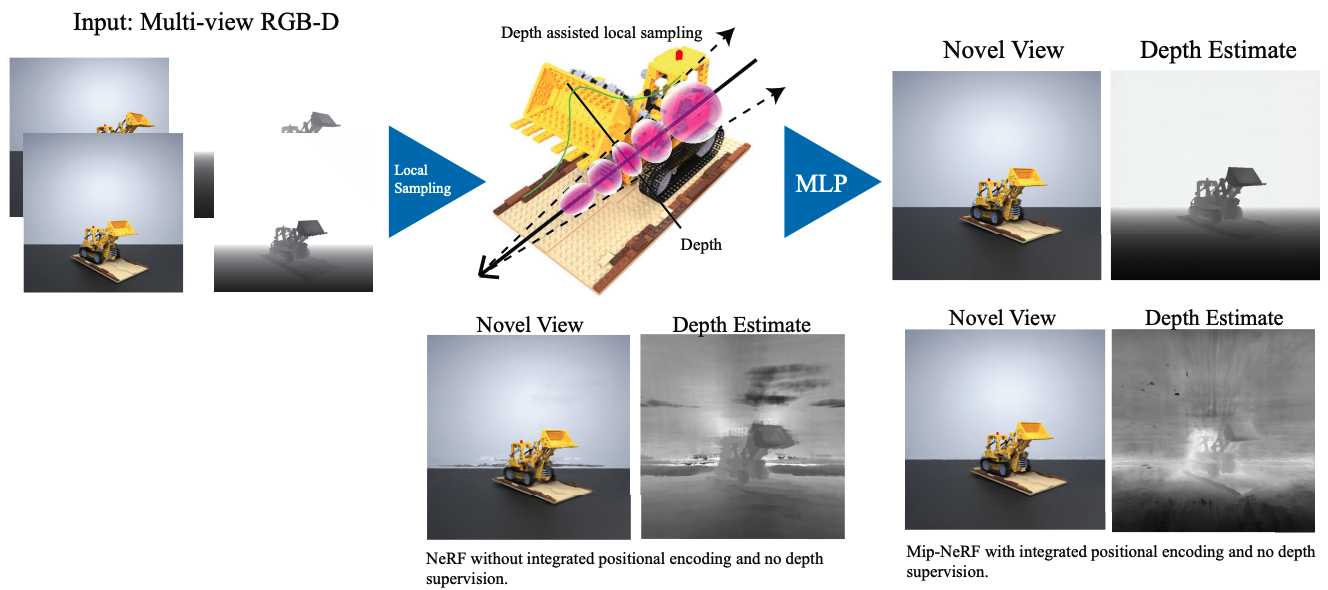
Mip-NeRF RGB-D: Depth-Assisted Fast Neural Radiance Fields
WSCG 2022, 2022
An extension of Mip-NeRF that integrates depth supervision from RGB-D sensors to accelerate training and improve geometric accuracy in neural radiance field reconstruction.
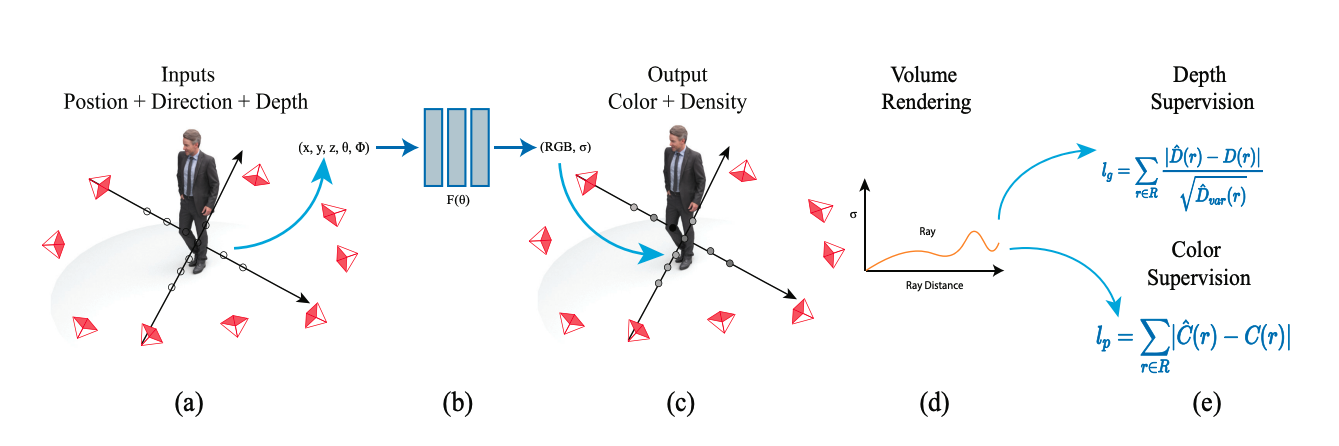
RGB-D Neural Radiance Fields: Local Sampling for Faster Training
EuroGraphics 2022, 2022
A depth-guided sampling strategy for Neural Radiance Fields that accelerates training by leveraging RGB-D sensor data to focus ray sampling along depth-informed segments, achieving faster convergence than standard NeRF.